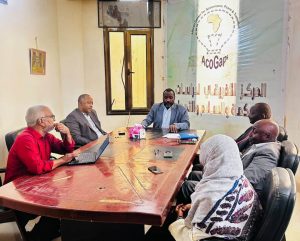
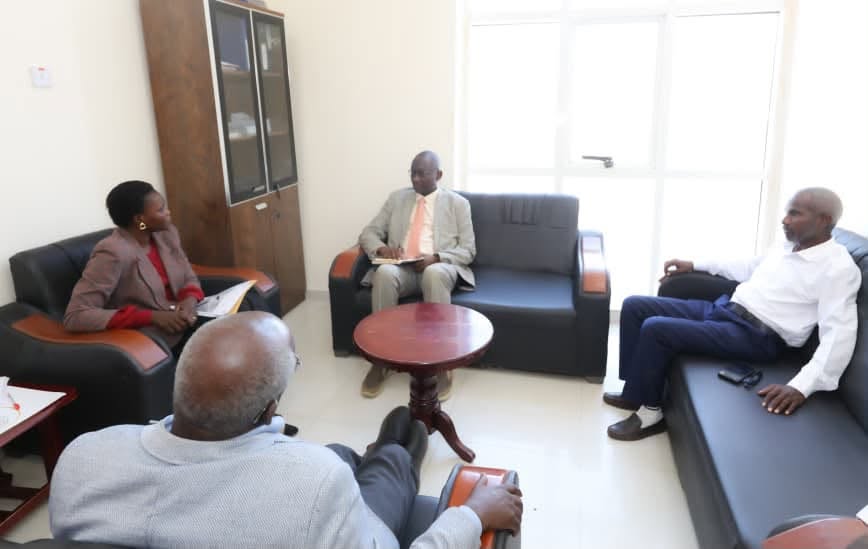
Dr. Natalina Yacoub, Secretary-General of the Supreme Council for Social Peace, met at her office with a delegation from the African Center for Governance, Peace, and Transformation Studies, led by Dr. Mahmoud Zain Al-Abedin, Director of the Center, and attended by Dr. Mohamed Hamid Al-Faki and Dr. Mohamed Adam Ahmed, experts at the Center.
The meeting aimed to strengthen joint cooperation and coordination between the Supreme Council for Social Peace and the African Center, exploring partnership prospects in initiatives related to social peace and community recovery.
During the meeting, the Secretary-General received a briefing from Dr. Mahmoud Zain Al-Abedin regarding the Center’s activities and programs, particularly in the fields of social peace, community recovery, and the formulation of plans, strategies, and programs aimed at peacebuilding and fostering social stability.
Both parties discussed the importance of prioritizing efforts during the post-conflict recovery phase, conducting a comprehensive survey to draft a conflict and community reconciliation map, and enhancing networking and coordination among various stakeholders in the field of social peace. This aims to unify efforts, integrate roles, and leverage academic and research expertise.
For her part, Dr. Natalina Yacoub emphasized the vital role played by research centers, civil society organizations, academics, and experts in supporting the Council’s efforts by providing programs, consultations, and scientific research that help address the root causes of conflict and deliver tailored solutions.
The Secretary-General affirmed the importance of launching joint projects between the Council and the African Center, as well as establishing a joint committee to coordinate and follow up on agreed-upon programs to serve social peace and promote a cohesive, peaceful society.
Furthermore, the meeting highlighted the necessity of consolidating efforts to counter the rise of hate speech and its destructive impact on the social fabric, while actively promoting a culture of dialogue, mutual tolerance, and peaceful coexistence as foundational pillars for societal peace and stability.
This meeting aligns with the Supreme Council for Social Peace’s strategy to broaden its partnerships with research, academic, and civil society institutions, drawing on national and African expertise to support social peace initiatives, mend the social fabric, and cultivate dialogue and tolerance among the components of Sudanese society.